Productions · 2010
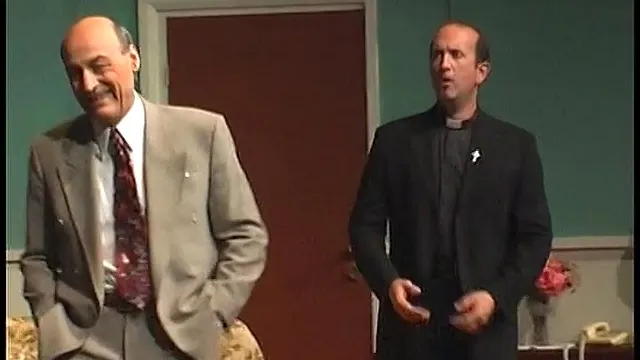
È uscito pazzo il parrocchiano!
Directed by Bruno Napolitano
Cast
- Don Sandro – parroco di Pietrascura
- Giovanni Conte
- Modestino – sacrestano
- Rino Pellone
- Rosa – domestica di Don Sandro
- Maria Conte
- Roberto – fratello di Don Sandro
- Rocco Loiacono
- Donna Bianca – baronessa
- Lina Del Borrello
- Matilde – sorella di donna Bianca
- Nicoletta Ciampini
- Ninetta – orfana
- Federica dei Giudici
- Andrea – figlio di donna Bianca
- Aldo Santalucia
- Vittorio – sindaco
- Luciano Pinto
- Il Vescovo
- Mario Ferri
- Celeste – fidanzata di Andrea
- Angela Signorile
- Menico – contadino
- Sam Pizzata
- Renato – macellaio
- Sergio Rizzi
- Elvira – moglie di Renato
- Marina Del Borrello
- Alcuni contadini
- Peppino Tizzano; Nick Agostino; Rosa Tizzano
About the play
Judged by many critics to be one of the best stage works by Di Maio, this play is in two parts rather then the standard three-act format. The dialogue is fast and sparkling with wit from first to last delivery; the action never slackens from the opening scene to the pealing of church bells that ends the play.
Don Sandro is a kind-hearted parish priest struggling to keep the faith among his small flock of simple folk by feeding them with fortuitous titbits of “divine” help that come their way through a series of “miracles” he cleverly orchestrates. His lawyer-brother, Roberto, tries to warn him about the local notable, a rather vulgar baroness, Donna Bianca, who has alerted the provincial Bishop (who happens to be her cousin) about these so-called miracles. In fact, there are personal interests behind her accusations because her rather parlous son, Andrea, wants to marry a young teacher, Ninetta, much to his mother’s disapproval; this in spite of the fact that they already have a baby.
Rosa, Don Sandro’s vibrant and vocal housekeeper, takes the side of the young unmarried mother (who is her god-daughter) and an open conflict flares up, with Don Sandro caught in the middle. Rosa and Sandro engage in constant verbal duelling on diverse matters, although the main bone of contention is the wrongs done to her god-daughter, who is denigrated by the others, especially the baroness, who seems determined to prevent a wedding at all costs.
Rosa manages to stir up Don Sandro so that when he Bishop arrives to put him in his place, it is instead the Bishop who finds himself checkmated by Don Sandro.
Rampant with a sense of social justice, he then proceeds to unmask the hypocrisy and the shabby lifestyle of the notables by means of a stratagem that sees them running for cover. In the end, the baroness comes to her senses and justice finally prevails.